
After an insightful presentation at Groundswell 2025 by Professor Tim Lang, Open Food Network UK’s Nick Weir shares his reflections and explores how OFN UK is playing a role in moving from a Just in Case model towards local food resilience.
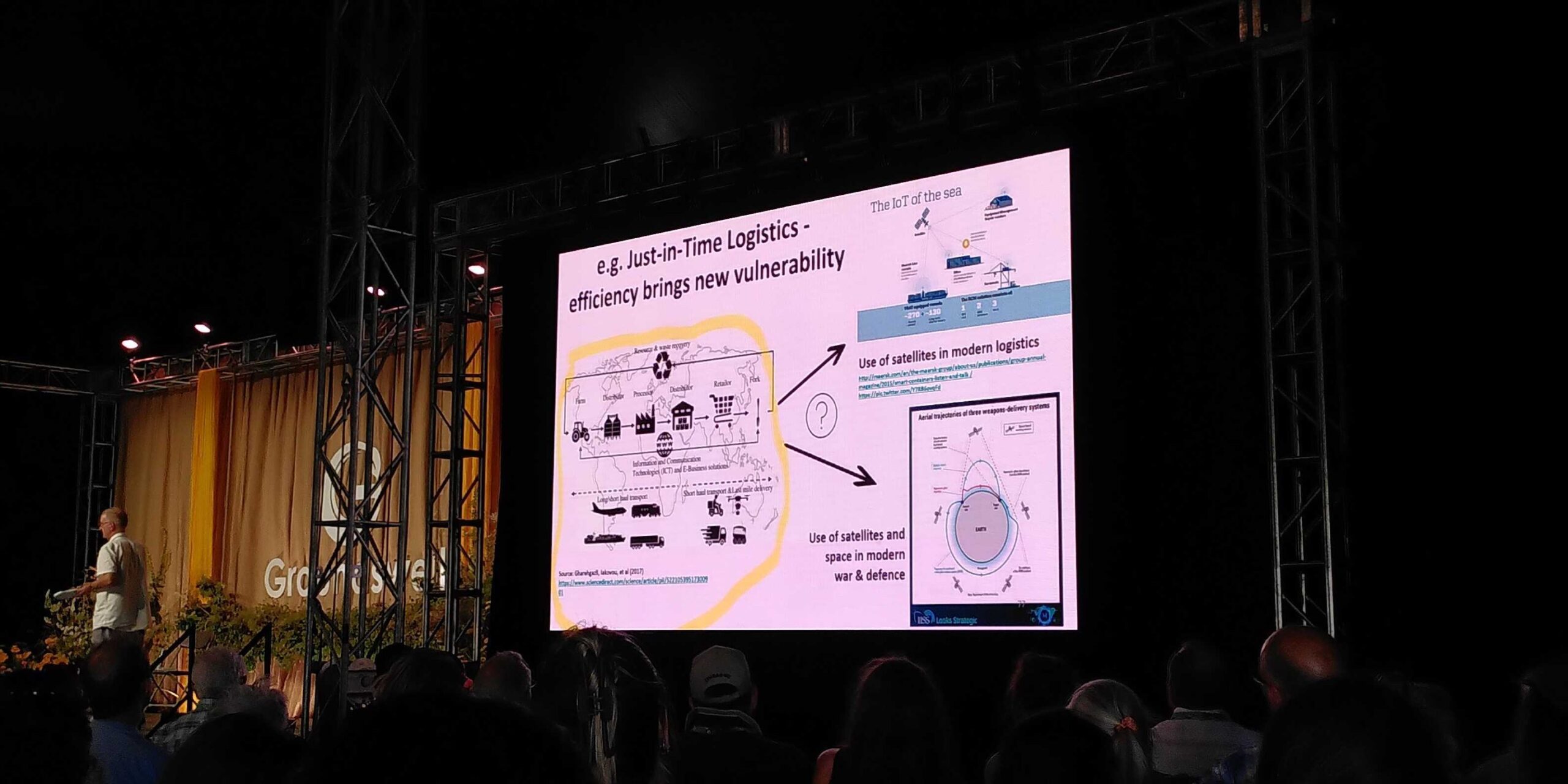
At Groundswell 2025, we heard Professor Tim Lang talking very powerfully about the dangers faced by the UK population due to the food shortages that he sees as being inevitable in the near future. Tim’s is by no means a lone voice here. This report by Deroche‑Leydier stresses the need for more resilient short food supply chains. This blog takes extracts from both Tim’s ‘Just in Case’ report and the Deroche‑Leydier report, then shows how the Open Food Network UK (OFN UK) has been addressing these issues since 2012.
The risks of a just-in-time approach
The resilience of food supply chains is becoming an increasingly important scientific and societal concern. This is due to the growing number of global crises occurring in rapid succession and to their increasingly complex consequences for these chains. Indeed, food system disruptions are expected to become increasingly frequent, largely due to the effects of global warming and an increase in geopolitical and economic instability (Pitt 2022). Furthermore, these disruptions are expected to increase not only in number but also in frequency, intensity, and diversity of impacts (Sanderson Bellamy et al. 2021). The preceding four years, which have been characterized by a series of disruptive events, provide a clear illustration of this trend. This accumulation of disruptions calls into question the resilience of food systems.
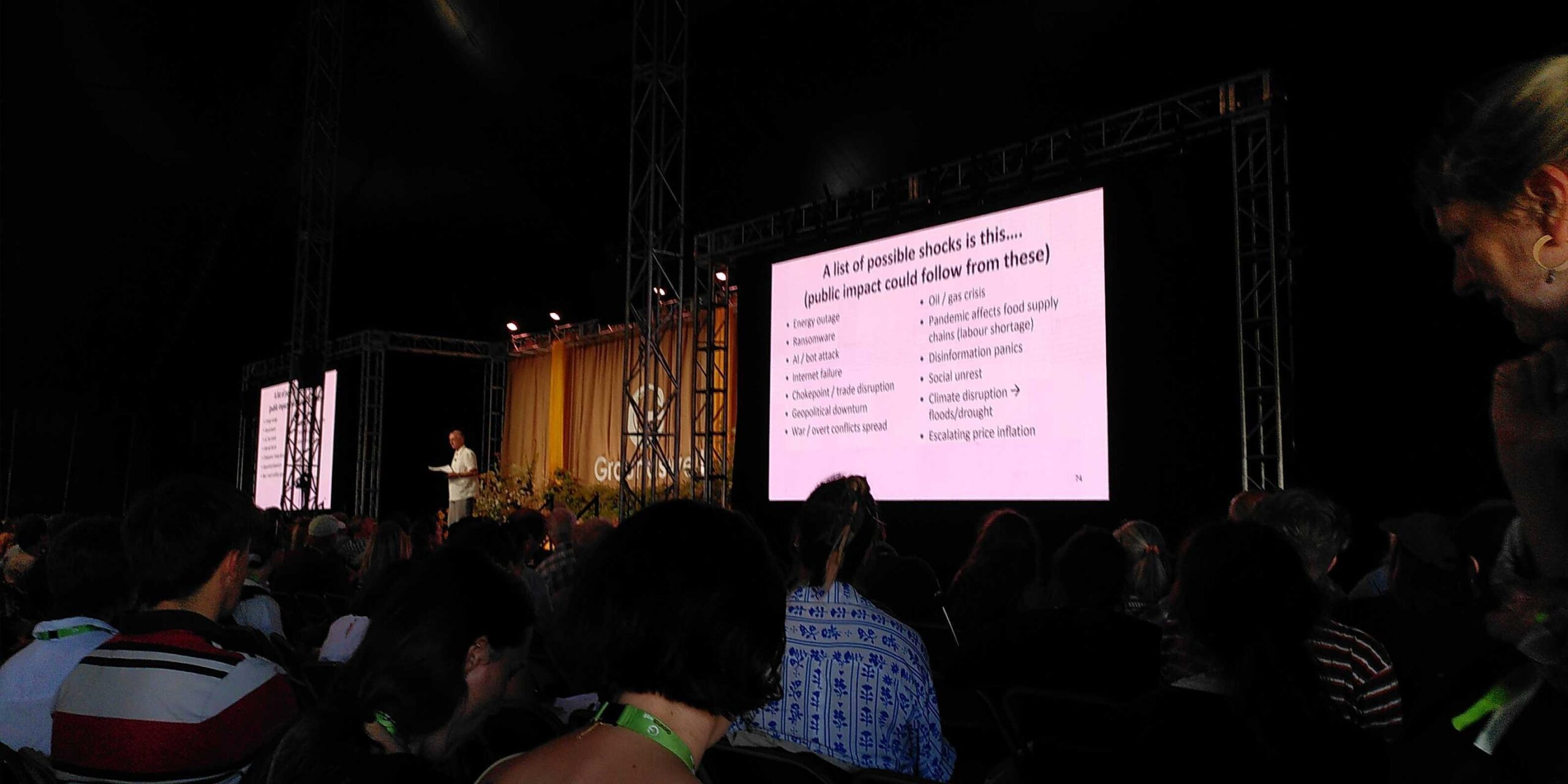
There is a danger of the UK repeating past mistakes, assuming others will always feed us and that the state has the military and logistics capacity to maintain food normality. It might not. The extensive (and anonymised) expert and food industry interviews conducted for this report were sober about lack of preparedness for shock. This is not helped by the absence of an integrated and coherent food policy. This gap should be a matter of national concern.
Tim’s concerns were further backed up by this open memo issued by several anonymous senior supermarket buyers recently. This whistleblowing memo from within top supermarket management states that: “What was a long term threat [to national food security] is now a short term threat. The balance of action needs to change. However, the risk is that we are entering a policy environment where companies are stepping back from rather than into the kind of action that is needed to secure their resilience.”
Towards local food resilience
At the Open Food Network UK, we are not waiting for our Government to develop an integrated and coherent food policy. Neither are we waiting for supermarkets to develop more resilient buying policies. Instead, we are building alternative food systems from the bottom up.
We believe that the current mainstream food system is failing largely due to issues of ownership and control. So the alternative system that we are building is open source – such that our platform is in common ownership and cannot be sold off or taken over by any profit-focused enterprise.
Many of the food producers using our platform are mainstream growers and farmers. However, our producer network also includes many of the alternative growing projects highlighted by Tim below.

Tim’s report goes on to explore the importance of community cohesion: “To address unequal capacity, there must be an emphasis on community support, not an individualised ‘look after yourself’ basis.”
The role of Open Food Network UK
Over the last twelve years, Open Food Network UK has been populated by over 900 community enterprises who are doing just this. Because these enterprises are embedded in their communities, they are intimately connected with local stakeholders and are able to respond very quickly to crises and shocks: meeting the needs of all members of the community and particularly those most vulnerable. Have a look at our case studies for more detail.
Some uncertainty in shock is inevitable; we don’t know how UK society will react in different circumstances. The point of improving civil food resilience is in part to reduce uncertainty. This raises the need for the public to take stock of its resources and to ensure some kind of equitable spread of facilities for civil food resilience.
During the Covid-19 pandemic lockdowns the fragile supermarket systems failed. At the same time, turnover through Open Food Network UK increased by over 850% in the first seven weeks of lockdown, as people fell victim to the fragility of the global supply chain and turned through necessity to their local short food supply networks.
Neighbourhoods and community resilience requires more attention; while some areas have strong community networks, this is not always the case. National resilience requires encouragement for those that have, and resources and leadership to build it where it is lacking. UK towns, cities and villages should initiate food resilience learning exchanges city to city, region to region, institution to institution as part of a public interest focus on living within planetary limits as survival.
Many of the long-term food hubs, online farmers markets, farm shops, food co-ops, buying groups and food banks on the Open Food Network UK are committed to sharing their success stories (and details of all the challenges they’ve encountered). You can access a lot of our recorded material here.
A number of studies highlighting the factors contributing to resilience emphasize particularly the positive impact of a diversity of outlets: these enable farmers to remain flexible and sustain their sales while reorganizing them (Benedek et al. 2022; Uliano et al. 2023).
Part of the huge increase in uptake of the OFN UK platform during lockdown was that food producers suddenly found the need to have multiple routes to market. Many of them tapped into the existing OFN UK network. Others quickly spun up either an individual shopfront or a multi-producer hub.
New urban-rural food connections are desirable (noting the French and Belgian experience), beginning to build shorter food routes, a more bio-regional approach and less reliance upon a few big retailer-dominated and over-centralised food distributors.
Tamar Valley Food Hubs pioneered the Good Food Loop, which has extended the functionality of the Open Food Network to link up multiple local hubs into a regional network. Other UK regions are taking this software and the expertise of the Tamar team and building regional food systems in other parts of the country.
Large food companies are now more nervous about extreme shocks. Lines of supply or decisions all going through single or few ‘hubs’ are intrinsically at risk from attack or disruption (see Figure 8). More decentralised systems are improvements but ultimately the most resilient and adaptive are what Paul Baran for RAND called ‘distributed’ systems. More distributed systems (particularly logistics) are desirable, and thus a degree of bio-regionalism. Modern food logistics are both lengthy and complex, but they mostly go through highly centralised systems of command and supply chain management. With so few companies responsible for high percentages of UK food retail, manufacturing and distribution, policymakers should take the case for diversification and appropriate regionalisation more seriously for resilience reasons. Reliance on relatively few hubs is intrinsically risk generating.
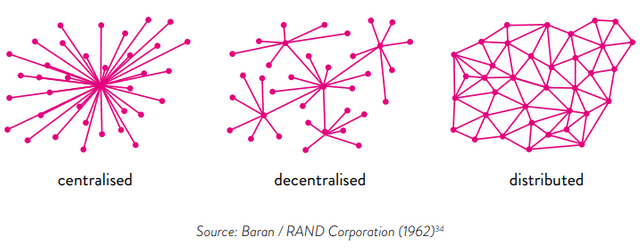
The distributed model that Tim describes here is exactly how the Open Food Network works both in the UK and across the globe – a diverse, multi-connected network of producers and businesses that is more resilient to risk and offers greater variety and choice for consumers, and keeps local money in the local economy.
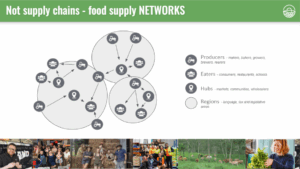
Be part of building your local food network
Are you interested in building your local food network? For more detail on the functionality of the Open Food Network for food growers, producers and sellers and any groups interested in establishing a food hub, please see our open source user guide here. To discuss how you might use the platform to build a resilient local food system in your area, please contact our Community Facilitator Nick Weir.
Featured image by Luismi Sánchez on Unsplash.